Beyond CRM: How Ayala Land Built a Sales Transformation That Actually Stuck

Why technology adoption is about outcomes, not features—and how one real estate company rewired its entire sales ecosystem around agent success.
The Problem Nobody Was Talking About
Ayala Land sits at the heart of the Philippines' real estate boom. With thousands of independent sales agents across multiple residential brands operating at scale, the company owns one of the most complex property sales ecosystems in the country.
But complexity breeds fragmentation.
Prior 2025, Ayala Land's sales infrastructure had become exactly what every enterprise warns against: a patchwork of disconnected systems. Sales, service, marketing, and commissions all lived in separate silos. Agents didn't have a single source of truth—they had multiple logins, inconsistent data, and a critical gap: no visibility into when they'd actually get paid.

The company knew it needed a CRM. But here's the thing: agents didn't care about CRM. They cared about selling. And making money.
The real problem wasn't missing technology. It was that the existing technology made selling harder, not easier.
The Insight That Changed Everything
Before rolling out any platform, Ayala Land's digital transformation team asked a deceptively simple question: What do agents actually need?
The answer reframed the entire initiative.
Agents don't adopt systems—they adopt outcomes. If a platform doesn't help them close deals or track earnings, it gets ignored. No amount of mandates, training, or incentives changes that.
The research surfaced four critical truths:
Value is defined by income impact. Agents operate like entrepreneurs. They measure success in earnings, pipeline control, and autonomy—not in process compliance.
Simplicity is a growth driver. Adoption isn't driven by features. It's driven by ease and immediacy. The most powerful tools feel effortless.
Real-time visibility creates relevance. Data only matters when it's timely, actionable, and directly tied to what agents care about: their performance and commissions.
One platform beats many every time. Multiple systems meant multiple contexts to switch between, multiple sources of truth to reconcile, and friction at every step. Agents needed one seamless place to sell, move, and earn.
Armed with this insight, the transformation team rejected the idea of a standard CRM implementation. Instead, they designed a unified performance engine that would turn the entire sales ecosystem inside out—not around systems, but around how agents actually sell.
The Solution: mySales360
Enter mySales360: a sales ecosystem built on Salesforce, but designed with a radically different purpose.
This wasn't "CRM" in the traditional sense. It was a system engineered around four innovation pillars:
1. Fragmented Tools → One Unified Ecosystem
A single source of truth across leads, customers, transactions, and commissions. Agents stopped context-switching. Everything they needed to sell, track, and earn appeared in one intuitive experience.
2. Passive CRM → Active Sales Engine
Instead of a database to update, mySales360 actively guided agents. It prioritized leads, surfaced next actions, and delivered real-time insights directly into the workflow—removing guesswork.
3. Delayed Commissions → Real-Time Motivation
Perhaps the most innovative move: transparent earnings visibility embedded directly into the sales workflow. Agents could track commission accrual in real time, seeing exactly when earnings would release. This transformed commissions from a mystery into a motivator.
4. Forced Adoption → Natural Usage
By designing around agent behavior, the platform became essential, not optional. Agents didn't adopt mySales360 because they had to. They adopted it because it made them more effective.
Making Adoption Stick: A Three-Phase Approach
Rolling out a new platform to thousands of independent agents is not a typical IT project. Ayala Land structured the adoption strategy in three deliberate phases:
Phase 1: Attract
The positioning was ruthless in its simplicity: mySales360 is a tool to sell smarter and track earnings in real time. Not "a new system you must use." Not "a compliance requirement." A tool that directly served agent interests.
Marketing emphasized what agents cared about: commission visibility, lead prioritization, and speed. The messaging was benefit-led, not feature-led.
Phase 2: Enable
The implementation embedded mySales360 into the natural workflow of agents—end to end. Training wasn't generic "how to click buttons." It was contextualized: dashboard walkthroughs, toolkits for specific roles, and guided usage paths that let agents see value immediately.
Simplified UX, unified tools (no more switching), and accessible training materials meant agents could start selling in the platform on day one.
Phase 3: Reinforce
Sustained usage was driven by continuous linkage between the platform and performance. Real-time commission tracking, automated notifications, and ongoing pipeline engagement kept agents coming back. The more they used mySales360, the more control and visibility they had.
The Results Speak for Themselves
Within three months of rollout:
95% seller activation — Daily usage across the agent network, with mySales360 becoming the default sales platform
Increased pipeline visibility — Agents generated more qualified opportunities through centralized lead management
Real-time commission tracking — Thousands of commission tranches visible and trackable, eliminating manual follow-ups and the uncertainty that used to plague the system
Faster conversions — Agents reported completing in minutes tasks that used to take hours
Natural adoption — Zero resistance from the field because the platform solved real problems
Agent feedback spoke louder than metrics:
"mySales360 has completely streamlined how I manage my leads. Everything I need is in one place."
"What used to take hours now takes minutes—converting and updating leads in just a few clicks."
"Having real-time visibility on my pipeline gives me better control and confidence in hitting my targets."
What This Transformation Really Proved
On the surface, mySales360 is a Salesforce-based sales platform. But the real story is different.
Ayala Land proved that digital transformation doesn't fail because of technology. It fails because it's designed around systems instead of the humans who have to use them.
The company didn't succeed because it picked the right vendor. It succeeded because it:
Started with the agent, not the enterprise
Designed for outcomes, not compliance
Built for simplicity, not comprehensiveness
Moved the needle on what mattered—in this case, commissions and visibility
These principles apply far beyond real estate. Any organization with a distributed workforce, high-volume transactions, or adoption challenges can learn from this playbook.
What's Next
mySales360 is one pillar of a broader digital transformation program at Ayala Land. The roadmap includes:
Full utilization and continuous enhancement based on ongoing agent feedback
Expansion to real-time commission visibility across the Pricing Module, extending the same principles to more complex compensation scenarios
AI-assisted property engagement embedded into the agent workflow, bringing intelligent support directly where agents sell
The transformation isn't a project. It's a foundation.
The Award
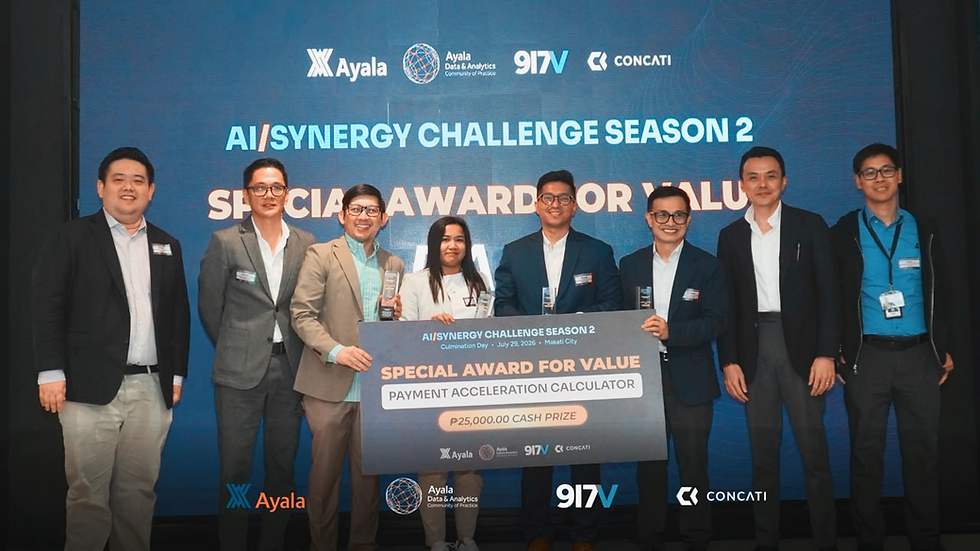
In 2026, Ayala Land received the Digital Transformation Program HR Excellence Award—a distinction that came with particular significance: Ayala Land was the only non-tech company recognized, standing alongside technology firms and innovation leaders in a category typically dominated by pure-play tech organizations.

This recognition validates a core belief at Ayala Land: digital transformation isn't about technology companies doing tech things. It's about any organization—regardless of industry—committing to reimagining how people work, how processes function, and how success gets defined.
The award reflects not just the launch of mySales360, but the philosophy behind it: that transforming a sales organization requires understanding your people first, designing systems they actually want to use, and measuring success by outcomes that matter to them—faster sales cycles, transparent earnings, and genuine autonomy.
For a real estate company in a traditional industry to earn recognition in a digital transformation category dominated by tech speaks to a powerful truth: the most innovative organizations aren't necessarily the ones with the latest technology. They're the ones that use technology as a tool to solve real human problems. And that insight transcends industry boundaries.
Key Takeaway
The most successful digital transformations aren't about technology—they're about understanding what your people need to do their jobs better, and building systems that disappear from the equation. When users forget they're using a system and just feel like they're working smarter, you've won.
About Ayala Land's Digital Transformation Program
Ayala Land's Corporate Services & Transformation Group (CSTG) and Enterprise Process and Performance Group (EPPG) drive digital initiatives across the organization. The transformation program emphasizes agent-centric design, real-time visibility, and outcomes-driven implementation across all platforms serving the Residential Business Group and beyond.


Comments